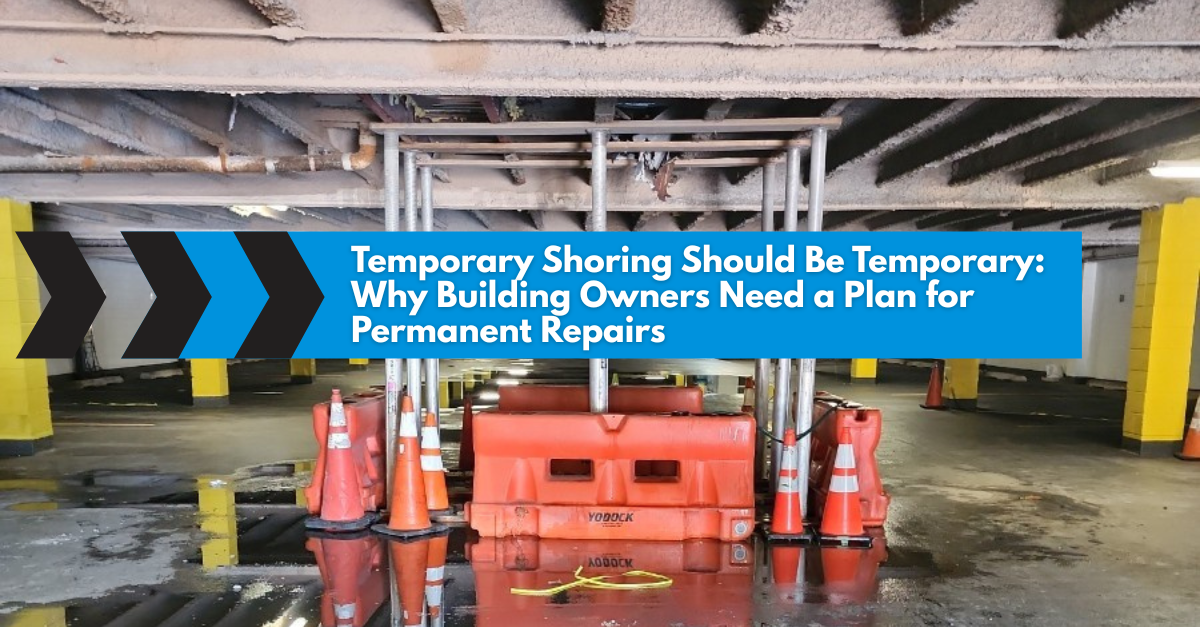
Temporary Shoring Should Be Temporary: Why Building Owners Need a Plan for Permanent Repairs
Temporary shoring can be an essential safety measure when a building or structure becomes compromised. But when temporary solutions remain in place for months or even years, building owners and property managers may be exposing themselves to additional risks, expenses, and potential municipal fines.
For commercial property owners, condominium associations, and property managers, discovering structural deterioration can create an immediate challenge. Whether the issue involves a parking garage, concrete slab, deteriorating support column, or another structural component, protecting occupants and the public must be the first priority.
Temporary shoring is often the first step toward stabilizing a compromised structure while engineers evaluate the condition and develop a repair plan. However, there is one important detail that building owners should not overlook: Temporary shoring is not intended to become a permanent solution.
As municipalities increase their attention to structural safety, inspections, and property maintenance, building owners may face greater scrutiny when temporary support systems remain in place without meaningful progress toward permanent repairs.
What Is Temporary Shoring, and Why Is It Necessary?
Temporary shoring is a support system installed to stabilize a structure or structural component that may no longer be capable of safely carrying its intended loads.
These systems are commonly used in parking garages, commercial buildings, multifamily residential properties, and other structures experiencing deterioration or damage.
Temporary shoring may be necessary when an engineer identifies conditions such as:
- Deteriorating concrete slabs, beams, or columns.
- Corrosion of reinforcing steel.
- Structural cracking or concrete spalling.
- Water infiltration that has contributed to structural deterioration.
- Compromised load-bearing components.
- Conditions requiring stabilization before repairs can safely begin.
When properly designed and installed, temporary shoring helps protect occupants, workers, and surrounding areas while the property owner determines the appropriate next steps. But installing shoring is only one part of addressing the underlying problem.
The Problem With Leaving Temporary Shoring in Place
It is not uncommon for temporary shoring to remain in place longer than originally anticipated. Perhaps the association is waiting for funding approval. The property owner is evaluating repair proposals. The engineering design is still being finalized. Or the project has been delayed due to budgeting, permitting, or contractor availability.
While these challenges are understandable, delaying permanent repairs can create additional complications. Temporary shoring does not eliminate the underlying structural deficiency. It only provides an engineered means of supporting the affected structure while the condition is addressed. Depending on the system and site conditions, prolonged use can introduce additional concerns.
- Continued structural deterioration
The condition that required shoring may continue to worsen, particularly when moisture intrusion, corrosion, or other sources of deterioration have not been corrected.
- Increased maintenance and monitoring
Temporary support systems may require ongoing inspections, adjustments, and maintenance under the direction of a qualified professional. They cannot simply be installed and forgotten.
- Disruption to building operations
Shoring can restrict parking spaces, limit access, interfere with building operations, and create inconvenience for residents, tenants, and visitors.
- Escalating repair costs
Delaying permanent repairs may allow deterioration to spread, potentially increasing the scope, complexity, and overall cost of the project.
- Potential code violations and municipal fines
Municipalities may require owners to address unsafe conditions within specified timeframes. When shoring remains in place without appropriate approvals, required inspections, or progress toward permanent repairs, owners may face violations, fines, or additional enforcement actions.
The longer temporary shoring remains in place, the more important it becomes to document its condition, maintain required inspections, and demonstrate a clear plan for resolving the structural issue.
Municipalities Are Paying Closer Attention to Temporary Structures
Building owners should also be aware that local governments may be taking a more aggressive approach to temporary structures that remain in place for extended periods.
New York City provides a recent example:
Through its Get Sheds Down initiative, the city adopted new requirements designed to discourage building owners from leaving temporary sidewalk sheds in place indefinitely.
Under legislation and enforcement rules adopted in 2025 and 2026, property owners may face financial penalties when sidewalk sheds remain in place without meaningful progress toward required repairs. The city has indicated that it expects to begin imposing these penalties in early 2027.
Although sidewalk sheds and structural shoring are different systems, the underlying message is relevant to both: Temporary safety measures should not become a substitute for addressing the underlying building condition.
In New Jersey, building owners must also comply with applicable construction codes, municipal ordinances, and enforcement orders. Failure to correct cited violations can result in penalties or further enforcement action.
Importantly, there is no single statewide deadline requiring all temporary structural shoring to be removed after a specific number of days. Requirements depend on the municipality, the structural condition, applicable permits, and the direction of the responsible engineer and code officials.
For property owners and associations, the best approach is to understand these requirements early rather than waiting for a violation or enforcement notice.
From Temporary Stabilization to Permanent Structural Repairs
Once temporary shoring has been installed, building owners should begin planning for permanent corrective work. A successful repair project typically involves several important steps.
Step 1: Obtain a comprehensive engineering assessment.
A qualified structural engineer should evaluate the deterioration, determine its cause, assess the condition of the temporary supports, and develop recommendations for permanent repairs.
Step 2: Establish the repair scope and budget.
Understanding the necessary work allows owners and associations to evaluate costs, prioritize repairs, and establish a realistic funding strategy.
Step 3: Develop a construction schedule.
A clearly defined schedule helps coordinate permitting, contractor availability, material procurement, and any operational disruptions.
Step 4: Complete the necessary structural repairs.
Depending on the condition, permanent repairs may involve concrete restoration, reinforcing steel repairs, waterproofing, structural strengthening, or replacement of deteriorated components.
Step 5: Obtain approval before removing temporary shoring.
Temporary supports must remain in place until the responsible qualified professionals determine that the structure can safely support the required loads and any necessary approvals have been obtained.
Removing temporary shoring prematurely can create significant safety risks.
Why Proactive Planning Can Save Building Owners Money
For condominium associations and commercial property owners, the financial implications of delayed repairs can extend well beyond the original construction budget. Consider a parking garage with deteriorating concrete slabs that require temporary shoring.
Initially, the supports may allow portions of the garage to remain operational while the owner evaluates repair options. But if the repair project is delayed for another year, the property may incur additional engineering inspections, maintenance expenses, lost parking revenue, and potentially more extensive concrete restoration.
If municipal enforcement becomes an issue, fines and compliance costs may add another layer of expense. What began as a manageable repair project can become a much larger financial and operational challenge. Addressing deterioration early is not simply a maintenance decision. It is an investment in the safety, functionality, and long-term value of the property.
How South Shore Construction Can Help
At South Shore Construction, we understand the challenges building owners, property managers, and condominium associations face when structural deterioration requires corrective action.
From parking garage restoration and concrete repairs to waterproofing and building restoration, our team works alongside owners, property managers, and engineering professionals to help move projects from assessment and planning to completed construction.
We understand that permanent repairs require careful coordination, particularly in occupied buildings where access, scheduling, budgets, and resident safety are important considerations.
Our goal is to help clients address deterioration proactively, minimize disruption, and protect their properties for the long term.
Temporary Shoring Is a Starting Point, Not the Finish Line
Temporary shoring serves an important purpose. It can provide critical structural support while building owners evaluate conditions and prepare for repairs.
But it should never become an excuse to postpone necessary work indefinitely.
As municipalities place greater emphasis on building safety and code compliance, property owners and associations should take a proactive approach to evaluating temporary support systems and developing permanent repair plans.
If your property has temporary shoring that has been in place longer than anticipated, now is the time to revisit your repair strategy.
Contact South Shore Construction to discuss your upcoming concrete restoration, parking garage repair, or structural rehabilitation project.



 202 E 11th Avenue

 732-750-5777