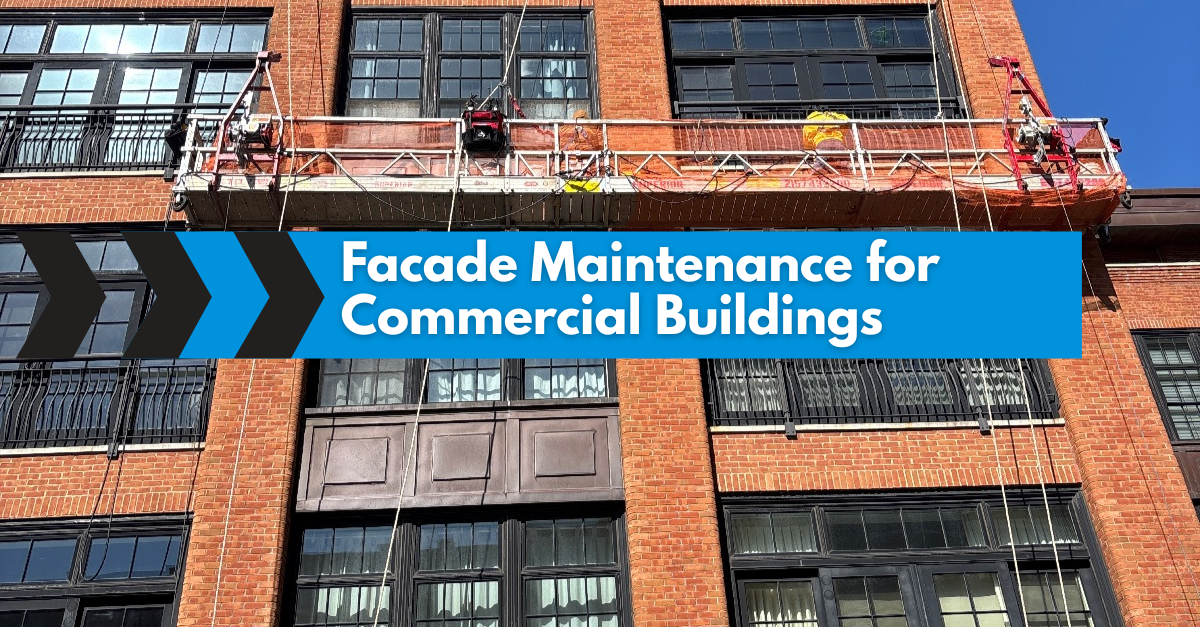
Facade Maintenance for Commercial Buildings: The Quiet Work That Protects Everything Inside
Every commercial building tells a story.
From the street, the façade is the first chapter—what tenants, visitors, inspectors, and passersby see before they ever step inside. But while most people admire a building’s exterior for its appearance, owners and property managers know the truth: a façade is not decoration. It is a system. And when that system is neglected, the consequences can be costly, disruptive, and dangerous.
Facade maintenance rarely makes headlines when it’s done right. But when it’s ignored, it quickly becomes the main character in a story no owner wants to tell.
The Hidden Problem Most Buildings Face
Commercial building owners are constantly balancing priorities: tenant satisfaction, operating costs, compliance requirements, capital planning. Facade maintenance often falls into the background because problems develop slowly and out of sight.
- Hairline cracks in masonry
- Deteriorating mortar joints.
- Corroding steel lintels.
- Failed sealants around windows.
- Water intrusion that hasn’t yet reached interior finishes.
None of these issues feel urgent until they are.
The reality is that facades don’t fail suddenly. They send warnings for years. The challenge is recognizing those signals early enough to act proactively instead of reactively.
The Real Risk Isn’t Aesthetics. It’s Exposure
When people think of façade maintenance, they often think about curb appeal. While appearance matters, it’s rarely the biggest risk.
The true dangers are structural and financial:
- Water infiltration that compromises interior finishes, structural steel, and concrete
- Freeze-thaw cycles that accelerate cracking and spalling
- Falling debris that creates liability exposure. This has been a rising issue in the news.
- Code violations and fines tied to inspection requirements (which are becoming more commonplace)
- Emergency repairs that cost significantly more than planned maintenance. (Think ER visit vs. regular physical)
In dense commercial environments, façade failures don’t just affect the building—they affect sidewalks, neighboring properties, and public safety (liability/insurance risks)
That’s why cities like New York, Jersey City, Cliffside Park (and growing) have enacted strict façade inspection programs. These regulations exist not to burden owners, but to avoid preventable failures and dangers.
Facades Are Systems, Not Surfaces
One of the most common misconceptions about façade maintenance is that it’s about fixing isolated issues.
In reality, a façade is an interconnected system made up of:
- Masonry or concrete assemblies (aesthetic finishes)
- Structural supports (typically steel or concrete)
- Flashing and waterproofing (to protect interior and filter water out of the building)
- Expansion joints and sealants (seal out weather and bugs)
- Windows, lintels, and shelf angles
A crack in masonry may be cosmetic—or it may be a symptom of movement, corrosion, or water infiltration elsewhere in the system. Repointing bricks without addressing underlying causes can provide short-term improvement while allowing long-term damage to continue.
Effective façade maintenance starts with understanding how these components work together and how failure in one area impacts the rest.
The Cost of Waiting Is Rarely Linear
Many owners delay façade repairs hoping to “get another year” out of the building envelope. While understandable, this approach often backfires.
Minor maintenance issues tend to escalate in three ways:
- Water spreads far beyond the visible damage
- Materials degrade faster once compromised
- Repairs become more invasive and disruptive
What could have been a localized repair often turns into scaffolding, sidewalk sheds, tenant coordination, and emergency scheduling.
Planned maintenance, by contrast, allows owners to:
- Budget accurately
- Schedule work during low-impact periods
- Avoid emergency premiums
- Extend the life of existing materials (preventative maintenance vs repairs)
What Proactive Facade Maintenance Looks Like
Responsible façade maintenance isn’t about over-repairing—it’s about informed decision-making.
A proactive approach typically includes:
- Regular visual inspections to identify early signs of deterioration
- Hands-on investigations where needed to confirm conditions
- Clear documentation of findings and priorities
- Phased repair plans aligned with budgets and building use
- Ongoing monitoring after repairs are completed
This process gives owners control. Instead of being surprised by violations or failures, they understand what their building needs now, next year, and five years from now.
The Role of the Contractor: Guide, Not Hero
In the best projects, the contractor doesn’t position themselves as the savior. They act as the guide bringing experience, clarity, and execution to a process the owner already owns.
That means:
- Explaining conditions in plain language
- Differentiating between urgent issues and future concerns
- Recommending solutions that align with the building’s age, use, and budget
- Executing work safely, cleanly, and with minimal disruption
When façade maintenance is approached this way, it becomes a partnership rather than a transaction.
Long-Term Thinking Protects More Than Buildings
Commercial facades protect more than bricks and mortar. They protect:
- Tenants who rely on safe environments to live and operate their businesses.
- Pedestrians who walk below every day hurried and distracted.
- The reputation of ownership and management
- The long-term value of the asset itself
Well-maintained buildings also send signals to tenants, lenders, and municipalities that ownership is responsible and invested.
That signal carries weight, especially in competitive commercial markets.
The Quiet Success Story
The best façade maintenance stories don’t involve emergencies or headlines. They look like this:
- A building passes inspections without violations and fines.
- Tenants never experience leaks which reduces turnover and management issues.
- Repairs are scheduled, not rushed.
- Budgets are predictable and funding is available when needed.
- The exterior ages gracefully instead of deteriorating visibly and compromising value.
It’s quiet work. Often invisible. But it’s foundational to the performance and longevity of any commercial building.
Facade maintenance isn’t about reacting to what’s broken. It’s about understanding what’s vulnerable and acting before risk becomes reality.
When owners are equipped with the right information and guided by experienced professionals, they stay in control of their buildings’ future. And that’s the kind of story every commercial property should be telling.



 202 E 11th Avenue
 732-750-5777